-
GROVO HR | THURSDAY, SEPTEMBER 8, 2016
 Make Your Company a Magnet for Millennials
As millennials flood the workforce, companies are seeing a massive drop in employee engagement — the lowest it’s been in the past eight years. Perhaps because 21st century employees are different from those in previous generations — such as their attention spans, how they consume content and how fast they’ll leave an employer they’re dissatisfied with. Further, replacing them is a massive challenge costing companies billions annually. Millennials look for companies that align with their core values. perk millennials seek when evaluating prospective employers. And that’s good for business.
-
GROVO HR | FRIDAY, AUGUST 19, 2016
 5 L&D Lessons We Can Learn From Olympic Champions
The 2016 Summer Olympic Games are in full swing in Rio de Janeiro! There’s so much we can learn from the Games about training and development, as there’s no better example of the power of great training than these incredible feats of athleticism. Here are five ways we can apply Olympic training strategies in our own organizations: Think about the future, but focus on the present. For Olympic hopefuls, long-term planning is just as important as short-term performance. The most effective L&D professionals use a similar two-tiered approach to training. Dreaming of tomorrow, disciplined today.
-
GROVO HR | THURSDAY, JUNE 23, 2016
 7 Keys To Building a High Impact Learning Culture
When Peter Cappelli published his book Why Good People Can’t Get Jobs several years ago, the Wharton Professor of Management highlighted the growing skills gap in today’s marketplace. His research showed that 50% of companies offer learning benefits, but the other half relied upon employees working independently to improve their skill sets. Today those numbers remain virtually unchanged. The study found: Only 41% of employees said they have opportunities to grow. 50% of companies have a mentoring program, but less than 40% of executives provide job shadowing and job rotation. Here’s how.
-
GROVO HR | TUESDAY, JUNE 14, 2016
 Yes, Millennials Are Real. Here’s What We Want.
A few months ago, I was at a family function when an older gentleman next to me in the beverage line started some friendly small talk. He was a former associate of someone’s, well into his retirement, and eager to chit-chat. We stood there and swapped a few pleasantries. Then, about a minute in, a strange look came over him. You need to help me,” he blurted. His eyes got big. He started fumbling frantically in his pockets. Oh no, I thought. Please don’t die. Finally, he pulled out an old iPhone. Gripped it like a brick, almost at arm’s length. Please. Make it stop.”. digital world.
-
GROVO HR | FRIDAY, JUNE 10, 2016
 The 5 Disorders Of Terrible Managers
Having a bad manager is like eating a bad burrito at lunch: it’s uncomfortable and stressful and makes you want to quit your job. The The sad thing is, a stressed-out employee usually means the manager is struggling too. Here are five disorders managers suffer from that inspire talented employees to take their talents elsewhere. They’ve turned into a robot. There needs to be some sort of human interaction between a manager and their reports. Talented employees don’t have the patience to answer to a machine. They want to work with people. Hello subordinate. 100-page report.
-
GROVO HR | TUESDAY, JUNE 7, 2016
 The Four Most Important Words In Human Resource Management
As I sat down to write this post (to tell you about a new HR communication product from Grovo, full disclosure), I began thinking about some of the most pressing questions facing our industry today: How can we improve the employee experience? How can we inspire a more engaged workforce? How can we attract and retain top millennial talent in an increasingly competitive market? These are complex challenges and there are no easy answers. But one thing is for certain. The economy is on the rebound, and what employees value today is changing before our very eyes. It’s called Grovo Handbook.
-
GROVO HR | FRIDAY, MAY 27, 2016
 Gallup Proves Why Millennials Need Better Managers
Ah, graduation season. That time of year when parents rejoice, students turn into professionals, and businesses brace for a horde of incoming hires they seem to not understand at all. At least that’s the sense I got from a Gallup report released last week. Evidently, millennials are having a tough time in the office. Disengagement is up, career happiness is down, and young people are on the move. All of it’s costing money, and worse, the high turnover is degrading the ability of organizations to plan for the future. The struggle is real. What’s going on here? The boss did it. Coincidence?
-
GROVO HR | WEDNESDAY, MAY 25, 2016
 You Know Nothing:5 Reasons Jon Snow NeedsManagement Training
Alert: spoilers below. Is Jon Snow a good manager? It’s a mixed bag. On the one hand, he’s had to deal with his share of adversity. Like many bosses, he was born a bastard, oversees a barren wasteland, and constantly fears betrayal. Despite these hardships, Jon continues to demonstrate positive leadership traits. He’s a great strategist. He’s principled. He doesn’t die. Overall, he’s a solid choice for Lord Commander of the Night’s Watch. Still, the challenges he’s faced have consistently been of a quantity and a severity , frankly, that a lot of managers seem to avoid. We’ll never know.
-
GROVO HR | FRIDAY, MAY 20, 2016
 How To Inspire Millennial Women to Take on Leadership
For the first time in history, as of October 2015 , more women in the U.S. held bachelor’s degrees than men. Unfortunately, higher levels of education don’t seem to be translating into more leadership ambition: according to a recent Pew study , 34% of millennial women say they aren’t interested in becoming top managers. Only 24% of millennial men felt that way. Perhaps it’s because the pressures of family and career are still palpable. Even in the era of post-Steinem feminism there’s still a gender pay gap , child care costs continue to rise , and the U.S. Support mothers and parents.
-
GROVO HR | THURSDAY, MAY 19, 2016
 Can We Please Stop Treating Employee Happiness Like A Metric?
For organizations, investing in employee happiness is just good business. Companies with happy employees outperform their competition by 20%. One out of every three employees would give up $5,000 in salary to be happier at work. And in the present era of job-hopping millennials and employee retention challenges, people do better work for longer when they’re happy. But somewhere along the line, companies systematized the idea of happiness too much. We turned it into just another key performance indicator. Another rule to be enforced. Attention companies: can we stop? We don’t need rules. Focus.
-
GROVO HR | TUESDAY, APRIL 19, 2016
 5 Reasons Quality Beats Quantity in Training Content
In the Internet age, information is limitless. Everything your employees need to know is out there on the World Wide Web. But who has that kind of time? Forcing your employees to CTRL F their way through search results in order to find the answers they need isn’t an efficient use of their workday. Learning can happen on the job, but in order to fit inside of busy schedules, it has to be tailored to your employees by you, the manager. When you curate the training your employees experience, it is: Role-specific: You know your employees better than anyone. They want the right thing.
-
GROVO HR | TUESDAY, JANUARY 12, 2016
 7 Things Every L&D Leader Can Learn From David Bowie
David Bowie is gone. It chills me just to type. He was so…not human. How could he be dead? Facing the strange indeed. As I sifted through various articles about his passing, I saw all sorts of words used to describe him: rock star, artist, visionary, chameleon, and my personal favorite: weirdo. It occurred to me that in the parlance of modern business, David Bowie was above all other things a thought leader. He took chances, stuck up for what he believed in, and pursued his own ideas about what great work could be. Doesn’t get any bigger. 1. Don’t wait for the next big thing. Become it.
-
GROVO HR | FRIDAY, DECEMBER 4, 2015
 The 5 Philosophies of a Great L&D Program
Never before has it been so easy to create, implement, or measure effective learning in your workplace. If you’re trying to inaugurate an L&D program at your office—or better yet, if you’re exploring how you could do it yourself—here are five learning philosophies to steer you in the right direction. “Guess who loves learning. This guy.” ” L&D’s real goal is long-term development. Training is an important function of any L&D program. People need to know how to do their jobs. That distinction goes to long-term development. But development is your north star.
-
GROVO HR | TUESDAY, DECEMBER 1, 2015
 Celebrate the 25th Birthday of Employee Engagement
An idea as powerful as employee engagement seems like it should have been around forever. Businesses have always employed people, after all, and people have always done their best work when they’ve cared about the outcome of their efforts. But managers haven’t always talked about the need to engage employees the way they’re talking about it today. Actually, employee engagement is a fairly young idea. It turns 25 years old this month, to be exact. In December 1990, Boston University professor William Kahn published the first-ever mention of “engagement” as we know it today. Engagement hr
-
GROVO HR | TUESDAY, NOVEMBER 17, 2015
 The (New) Definition of Employee Engagement
Employee engagement has been one of the most talked-about topics in human capital management for twenty-five years. And yet, despite the attention of professionals from every area of the business world—or maybe because of it—the term itself has never gained a universal definition. There’s no reason it couldn’t, though. On the whole, all of us who talk about ’employee engagement’ are broadly talking about the same concept, even if it’s easier to identify in practice than to dissect and name. This is our proposed definition of ‘employee engagement’ and the thinking that went into it.
-
GROVO HR | FRIDAY, NOVEMBER 6, 2015
 Do Emotions Belong In The Workplace?
Knowledge workers care about what they do for a living. They can’t help it. A job in the knowledge economy requires years of education, innate talents, and a lot of an employee’s time. It’s not just button-pushing. Asked to bring their whole selves to the job, modern knowledge workers crave work that engages their whole selves—including their emotions. Problem is, emotionality is still an uncomfortable topic in today’s corporate culture. Managers struggle with the question: does employee engagement and cultural alignment require an emotional dimension? Do emotions even belong in the workplace?
-
GROVO HR | WEDNESDAY, OCTOBER 28, 2015
 Develop or Die: 6(66) Ways To Save Your Organization From the Working Dead
In organizations all over the world, employees are dying inside. They drag themselves to the office and perform their jobs just well enough to not get fired. They nap, snack, and lumber around the workplace, haplessly killing time and strangling your bottom line. There’s only one way to describe these poor souls: occupational zombies , otherwise known as The Working Dead. They are lurking in every corner of your organization, and it’s up to you to save them before they ruin your business (either by staying… or leaving). It’s not that these creatures are lazy. That someone is you. Engagement h
-
GROVO HR | THURSDAY, OCTOBER 15, 2015
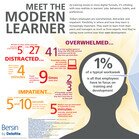 7 Things We Learned From Deloitte’s “Meet the Modern Learner”
Bersin by Deloitte’s infographic “ Meet the Modern Learner ” is a snapshot of the challenges facing learning professionals today. For those of us who seek to create high-quality training for 21st century brains, “Modern Learner” is more incisive a presentation of the way modern workers learn than most lengthy research reports. Here are our biggest takeaways from this latter-day L&D classic: Click here for large version. Learning needs to be micro. The central theme of the infographic is the fractured nature of the modern attention span. Workplaces need to be more aligned.
-
GROVO HR | TUESDAY, OCTOBER 6, 2015
 How One Innovative L&D Professional is Engaging Employees As a Training Department of One
Georgette Vlangos runs CHOPT Creative Salad’s entire learning program by herself. Since joining the innovative salad chain in December of last year, she’s revolutionized the company’s approach to training its growing workforce despite being the sole member of her team. It’s a monumental task—one that requires precise time management, clear tactics, and a lot of energy. Vlangos isn’t complaining. “In my career, I’ve been a department of one more than I’ve been a department of more-than-one,” she laughs. CHOPT’s Director of Training Georgette Vlangos.
-
GROVO HR | THURSDAY, SEPTEMBER 24, 2015
 A New Definition of Employee Engagement: Think Of It Like Your Health
What exactly is employee engagement? We know it’s a topic trending in every corner of the L&D world. We know it has something to do with being “all-in” on work. Mostly, though, we know that no one knows quite what it is. Dig into the issue for a few minutes and you’re likely to see more definitions of engagement than you have employees to engage. Why is it so hard to agree on the core of the problem we’re all trying to solve? It could just be that “engagement” isn’t a conveniently identified concept. The health of your body isn’t identified by any single quality or characteristic.
-
GROVO HR | THURSDAY, SEPTEMBER 17, 2015
 What Pro Quarterbacks Teach Us About Employee Development
The throwing motion of a quarterback is the most complex motor skill in all of sports. Hundreds of elements in the passer’s technique need to be perfect in order for the ball to reach its target. Decisions have to be made in fractions of a second. To To quarterbacks in the National Football League, a chain of actions with no margin of error are all that separate victory from calamity. football team’s fate depends on the skill of its quarterback. For that reason, truly elite passers are nearly priceless to the organizations that employ them. Beckham Jr. cementing his legacy.
-
GROVO HR | TUESDAY, SEPTEMBER 8, 2015
 7 Powerful Tips For Effectively Training And Developing Millennial Employees
Which side of the millennial fence are you on? Do you consider them spoiled trophy kids whose job-hopping tendencies make them poor candidates for long-term development? Or tech-savvy, civic-minded individuals capable of making lasting contributions to your organization with the right support? Polarizing as they are, there’s one thing we all can agree on about millennials: they’re different from any generation that’s come before. And if we want to engage them at work, we need to rethink the way we approach organizational learning. Here are 7 powerful tips to get you started. Get role-specific.
-
GROVO HR | THURSDAY, AUGUST 27, 2015
 5 Media Tricks That Build Culture Through Learning
More media outlets exist today than ever before. generation ago, most people got their current events from relatively few sources: periodicals, broadcast news, and, quite literally, the water cooler. These same outlets still exist in the 21st century, but they’ve been joined by a universe of new content sources, including social media and the blogosphere—information reservoirs of unfathomable depth. Given the 21st century’s endless number of news sources, it seems counterintuitive that the world today could be more aligned on current events than it’s ever been. You cared. Go viral.
-
GROVO HR | SATURDAY, AUGUST 22, 2015
 Why Every New Hire Needs A Mentor
The best way to convey the value of constant development to new hires is to get them familiar with what proven success in your organization looks like. Give every rookie that joins your company a mentor to guide them. Choose mentors from among the best veteran performers at the organization, establish interface between them and new employees, and watch as your recruits onboard smoothly. Here’s why mentoring works: It makes them feel valued. One of the best ways for an organization to show a new hire that they’re serious about development is to grant them the time of a senior employee.
-
GROVO HR | WEDNESDAY, JULY 8, 2015
 The Surprising Difference Between Millennials and Baby Boomers at Work
What exactly makes millennial employees different from their older colleagues? We know that it’s something. Research reports, with titles like “ Millennials at work: Reshaping the workplace ” and “ How Millennials Could Upend Wall Street and Corporate America ,” commonly portray them more like an invading army than a generation maturing into adulthood. Businesses are terrified of not being prepared to engage, retain, or even communicate with millennial workers. The mystique isn’t unwarranted, but it may be exaggerated. than in traditional social norms. Grovo Sapiens. Job hopping” is the term.
-
GROVO HR | MONDAY, JULY 6, 2015
 What the Grateful Dead Can Teach Us About Employee Engagement
A lot of L&D leaders are spending their summer days cooped up inside, thinking L&D thoughts, and worrying. Specifically, many are anxious about employee engagement. How exactly does one get a changing workforce to engage in the work they do every day? How should we define engagement beyond platitudes? What does engagement feel like? Luckily, summer is jam band season. And if there’s anything on this earth that can serve as a handy analogy—no, a paragon—of workplace engagement, it’s an improvisational jam. Learn to play with others , but not just songs you know. Get ready to get weird.





Let's personalize your content